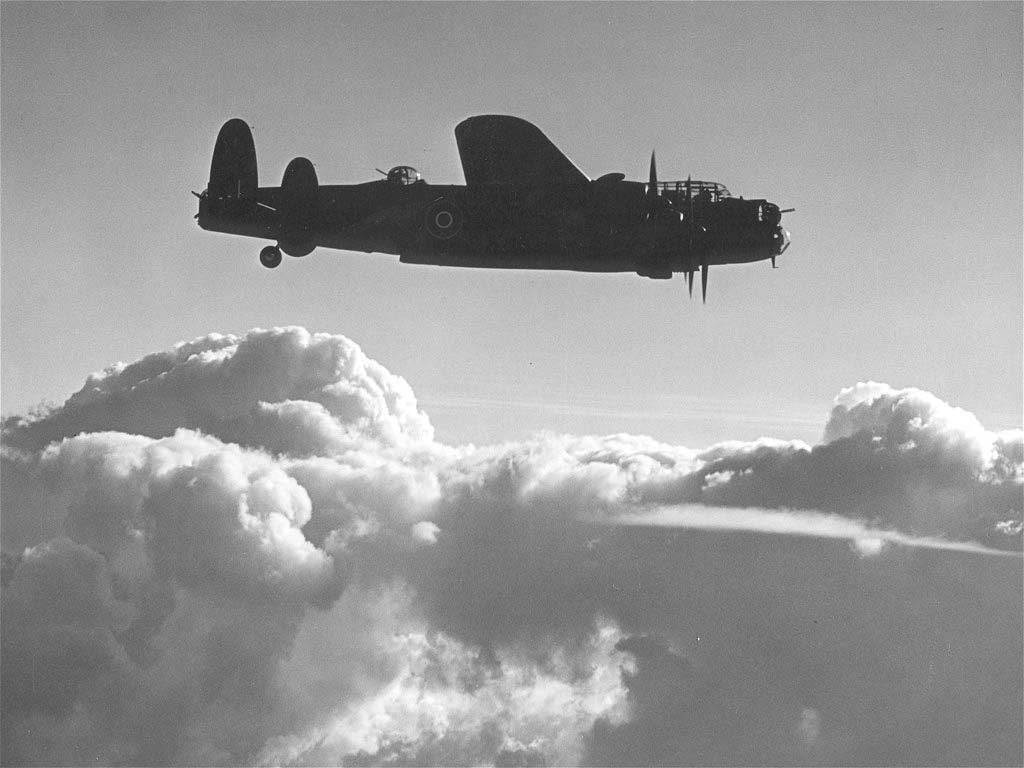
He flew with a Avro Lancaster (type III, serial ND520, code KM-A).
27 February 1944
TACTICAL OPERATIONS
(Ninth Air Force): Major General Elwood R Quesada (reappointed Commanding General IX Fighter Command on 21 Feb) receives authority to revive the IX Fighter Command (existing only on paper since creation of the IX Air Support Command) on a temporary basis as an operational HQ to function as a Combined Control Center with RAF 11 Group at Uxbridge, England, where Fighter Command will prepare operations orders for Ninth Air Force fighter and fighter-bomber groups.
Quesada retains command of the IX Air Support Command.
28 February 1944
STRATEGIC OPERATIONS
(Eighth Air Force): Missions 237, 238 and 239 are flown today against targets in France; 7 B-17s are lost.
Heavy clouds cause over half the bombers dispatched to return without bombing.
Mission 237: 49 of 81 B-24s hit the Ecalles sur Buchy V-weapon sites; 1 B-24 is damaged.
Escort is provided by 61 P-47s.
Mission 238: 258 B-17s are dispatched against V-weapon sites in the Pas de Calais; 109 hit the primary target, 10 hit a road junction E of Yerville, 7 hit a rail siding SW of Abbeville and 6 hit targets of opportunity; 7 B-17s are lost and 75 damaged; casualties are 5 WIA and 63 MIA.
Escort is provided by 81 P-38s, 94 P-47s and 22 P-51s; 1 P-38 is damaged beyond repair; the P-51s claim 1-0-0 Luftwaffe aircraft on the ground.
Mission 239: 5 of 5 B-17s drop 250 bundles of leaflets on Amiens, Rennes, Paris, Rouen and Le Mans, France at 2023-2055 hours without loss.
TACTICAL OPERATIONS
(Ninth Air Force): 180 B-26s attack NOBALL (V-weapon) targets and Rosieres-en-Santerre, France. Bad weather makes bombing difficult and causes 34 other B-26s to abort.
594 aircraft - 461 Lancasters, 123 Halifaxes, 10 Mosquitos - on the first large raid to Augsburg. The various diversions and the splitting of the main bomber force into 2 waves again reduced casualties still further. 21 aircraft - 16 Lancasters, 5 Halifaxes - lost, 3.6 per cent of the force; at least 4 of these casualties were due to collision.
The bombing at Augsburg was outstandingly successful in clear weather conditions and against this 'virgin' target with only weak flak defences. The Pathfinder ground-marking was accurate and the raid became controversial because of the effects of its outstanding accuracy. The beautiful old centre of Augsburg was completely destroyed by high explosive and fire, with much less than the usual spread of bombing to the more modern outer areas, where some industry was located. There were 246 large or medium fires and 820 small ones; the temperature was so cold (minus 18" Celsius) that the River Lech was frozen over and many of the water hoses also froze. The Germans publicized it as an extreme example of 'terror bombing'.
131 aircraft minelaying in Kiel Bay, 22 Mosquitos to airfields in Holland, 15 Mosquitos on diversionary raids to 4 towns to the north of the Augsburg routes, 5 RCM sorties, 10 Serrate patrols. 3 Halifaxes and 1 Stirling lost from the minelaying operation.
Total effort for the night: 777 sorties, 25 aircraft (3.2 per cent) lost.
This record can also be found on the maps of WW2 History Europe with Google coordinates. You can find the maps by clicking on this link on this location.
There are several possibilities to investigate the flight records on WW2 History Europe. All the flights are plotted on maps, sorted "day by day", "by squadron", "by type aircraft", "by year or month", "by location" and much more! Don't miss this!!!
If you have any information that you want to share, please add your comment at the bottom of this record. Or send your information to [email protected]. This information will be added to the record.
Your photos and your information are very welcome! The young do care and with your help we keep up the good work.