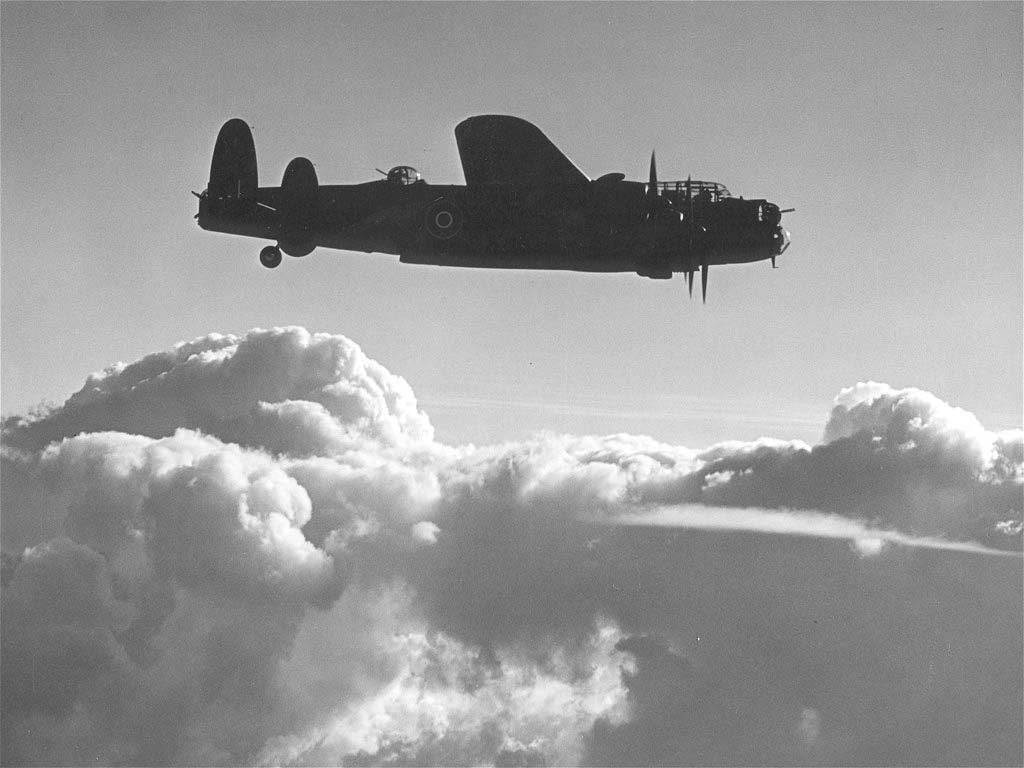
He flew with a Avro Lancaster (type III, serial ND525, code KM-Q).
24 February 1944
STRATEGIC OPERATIONS
(Eighth Air Force): 231 B-17's bomb Schweinfurt ball bearing plant (11 losses suffered) while 238 B-24's hit factory and airfield at Gotha (33 aircraft lost). 236 Heavy bombers attack secondary target of Rostock due to overcast at primary objectives of Poznan, Tutow, and Krzesiny. 61 Heavy bombers attack Eisenach, a target of opportunity. RAF Bomber Command follows up with attack during 24/26 Feb of Schweinfurt.
TACTICAL OPERATIONS
(Ninth Air Force): Advanced HQ IX A Spt Cmd (set up at Uxbridge on 15 Feb) assumes operational control of its groups, which hitherto had operated under orders from VIII FC. 22 B-26's bomb A/Fs at Leeuwarden, Deelen, and Gilze-Rijen on morning mission. 145 B-26's bomb NOBALL targets between Saint-Omer and Abbeville during afternoon."
25 February 1944
STRATEGIC OPERATIONS
(Eighth Air Force): Mission 235: In the final "Big Week" mission, 4 targets in Germany are hit; 31 bombers and 3 fighters are lost.
1. 268 B-17s are dispatched to aviation industry targets at Augsburg and the industrial area at Stuttgart; 196 hit Augsburg and targets of opportunity and 50 hit Stuttgart; they claim 8-4-4 Luftwaffe aircraft; 13 B-17s are lost and 172 damaged; casualties are 12 WIA and 130 MIA.
2. 267 of 290 B-17s hit aviation industry targets at Regensburg and targets of opportunity; they claim 13-1-7 Luftwaffe aircraft; 12 B-17s are lost, 1 damaged beyond repair and 82 damaged; casualties are 4 KIA, 12 WIA and 110 MIA.
3. 172 of 196 B-24s hit aviation industry targets at Furth and targets of opportunity; they claim 2-2-2 Luftwaffe aircraft; 6 B-24s are lost, 2 damaged beyond repair and 44 damaged; casualties are 2 WIA and 61 MIA.
Escort is provided by 73 P-38s, 687 Eighth and Ninth Air Force P-47s and 139 Eighth and Ninth Air Force P-51s; the P-38s claim 1-2-0 Luftwaffe aircraft, 1 P-38 is damaged beyond repair; the P-47s claim 13-2-10 Luftwaffe aircraft, 1 P-47 is lost and 6 damaged, 1 pilot is MIA; the P-51s claim 12-0-3 Luftwaffe aircraft, 2 P-51s are lost and 1 damaged beyond repair, 2 pilots are MIA.
Mission 236: 5 of 5 B-17s drop 250 bundles of leaflets on Grenoble, Toulouse, Chartres, Caen and Raismes, France at 2129-2335 hours without loss.
TACTICAL OPERATIONS
(Ninth Air Force): Major General Paul L Williams becomes Commanding General IX Troop Carrier Command.
191 B-26s bomb Venlo, Saint-Trond, and Cambrai/Epinoy Airfields, France in a morning raid as a diversion in support of the VIII Bomber Command heavy bombers over Germany; 36 abort, mainly because of a navigational error; 164 B-26s dispatched against military targets in France during the afternoon are recalled because of bad weather.
734 aircraft - 554 Lancasters, 169 Halifaxes, 11 Mosquitos - carried out the first Bomber Command raid on Schweinfurt, home of Germany's main ball-bearing factories. 266 American B-17s had raided the factories the previous day.
Bomber Command introduced a novel tactic on this night. The Schweinfurt force was split into two parts - 392 aircraft and 342 aircraft, separated by a 2-hour interval. Part of the German fighter force was drawn up by earlier diversions. The first wave of the Schweinfurt bombers lost 22 aircraft, 5.6 per cent; the second wave lost only 11 aircraft, 3.2 per cent, and it is believed that only 4 bombers from the second wave were shot down by night fighters. Total losses were 33 aircraft - 26 Lancasters, 7 Halifaxes - 4.5 per cent of the force.
179 training aircraft on a diversionary sweep over the North Sea, 60 Halifaxes and 50 Stirlings minelaying in Kiel Bay and the Kattegat, 15 Mosquitos to airfields in Holland, 8 Mosquitos to Kiel and 7 to Aachen, 12 Serrate patrols. 2 Stirlings were lost from the minelaying operation and 1 Serrate Mosquito of No 141 Squadron was lost, the first Serrate aircraft to be lost under Bomber Command control. 5 Wellingtons laid mines off Lorient without loss.
Total effort for the night: 1,070 sorties, 36 aircraft (3.4 per cent) lost.
594 aircraft - 461 Lancasters, 123 Halifaxes, 10 Mosquitos - on the first large raid to Augsburg. The various diversions and the splitting of the main bomber force into 2 waves again reduced casualties still further. 21 aircraft - 16 Lancasters, 5 Halifaxes - lost, 3.6 per cent of the force; at least 4 of these casualties were due to collision.
The bombing at Augsburg was outstandingly successful in clear weather conditions and against this 'virgin' target with only weak flak defences. The Pathfinder ground-marking was accurate and the raid became controversial because of the effects of its outstanding accuracy. The beautiful old centre of Augsburg was completely destroyed by high explosive and fire, with much less than the usual spread of bombing to the more modern outer areas, where some industry was located. There were 246 large or medium fires and 820 small ones; the temperature was so cold (minus 18" Celsius) that the River Lech was frozen over and many of the water hoses also froze. The Germans publicized it as an extreme example of 'terror bombing'.
131 aircraft minelaying in Kiel Bay, 22 Mosquitos to airfields in Holland, 15 Mosquitos on diversionary raids to 4 towns to the north of the Augsburg routes, 5 RCM sorties, 10 Serrate patrols. 3 Halifaxes and 1 Stirling lost from the minelaying operation.
Total effort for the night: 777 sorties, 25 aircraft (3.2 per cent) lost.
This record can also be found on the maps of WW2 History Europe with Google coordinates. You can find the maps by clicking on this link on this location.
There are several possibilities to investigate the flight records on WW2 History Europe. All the flights are plotted on maps, sorted "day by day", "by squadron", "by type aircraft", "by year or month", "by location" and much more! Don't miss this!!!
If you have any information that you want to share, please add your comment at the bottom of this record. Or send your information to [email protected]. This information will be added to the record.
Your photos and your information are very welcome! The young do care and with your help we keep up the good work.