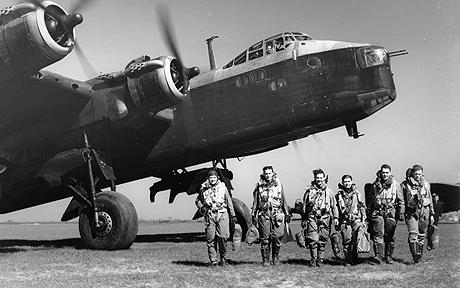
He flew with a Short Stirling (type I, serial W7618, code HA-V).
(8th Air Force): Mission 2: 22 of 24 B-17s bomb Abbeville/Drucat Airfield, France at 1032-1040 hours; 3 B-17s are damaged; 6 B-17s fly a diversion and 2 airmen are WIA. This mission is flown to occupy the Luftwaffe and prevent them from opposing an invasion by over 5,000 Allied troops, mostly Canadians, who raid Dieppe, France. 123 Spitfire Mk Vs of the 31st Fighter Group support the raid on Dieppe and claim 1-1-5 Luftwaffe aircraft with the loss of 8 Spitfires (4 pilots are MIA); 2d Lieutenant Samuel F Junkin Jr of the 309th Fighter Squadron, 31st Fighter Group, flying a Spitfire Mk V in support of the amphibious raid on Dieppe, shoots down a German fighter, this being the first aerial victory won by an 8th Air Force fighter pilot flying from the UK. Units arriving in England from the US: HQ 1st Bombardment Wing at Brampton Grange; 353d and 419th Bombardment Squadrons (Heavy), 301st Bombardment Group (Heavy), at Chelveston with B-17s (first mission is 2 Oct). 2d, 4th and 5th Fighter Squadron, 52d Fighter Group arrive at Eglinton, Co Derry, Ireland from the US (squadrons will be equipped with Spitfire Mk Vs and 2d and 4th Fighter Squadrons will fly their first mission on 27 Aug; 5th Fighter Squadron will not fly missions).
20 August 1942 (8th Air Force): The principle of coordinated day and night bombing receives its first formal definition in the "Joint British/American Directive on Day Bomber Operations involving Fighter Cooperation." The emphasis is placed on achieving continuity in the bombing offensive from the UK. Mission 3: 11 of 12 B-17s bomb Amiens/Longeau marshalling yard, France at 1801 hours without loss. Unit moves in England: 27th Fighter Squadron, 1st Fighter Group, from Atcham to High Ercall (the squadron is operating from Reykjavik, Iceland with P-38s); 352d Bombardment Squadron (Heavy), 301st Bombardment Group (Heavy) to Podington from the US with B-17s (first mission is 5 Sep).
Flensburg
118 aircraft, including 31 Pathfinders. 4 aircraft - 2 Wellingtons, 1 Halifax, 1 Stirling - lost, 3.4 per cent of the force.
Flensburg, on an inlet of the Baltic, was in theory an easy target for the Pathfinders on their first operation but the winds encountered were not as forecast and the bomber force drifted north of the target to a part of Denmark whose coast also had many inlets. 16 Pathfinder crews claimed to have marked the target area and 78 Main Force crews also claimed to have bombed in the correct place. Flensburg reports that the town was not hit at all but a Danish report shows that the towns of Sønderborg and Abenra and a large area of Denmark up to 25 miles north of Flensburg were hit by scattered bombing. 26 houses were destroyed and 660 were damaged but only 4 Danish people were injured.
9 Wellingtons laid mines in the Frisian Islands without loss.
The Dieppe Raid
2 Group flew 62 Boston smoke-laying and bombing sorties in support of the Canadian landing at Dieppe; some crews carried out more than 1 flight. 3 Bostons were lost.
1 Mosquito sent to bomb Bremen did not return.
This record can also be found on the maps of WW2 History Europe with Google coordinates. You can find the maps by clicking on this link on this location.
There are several possibilities to investigate the flight records on WW2 History Europe. All the flights are plotted on maps, sorted "day by day", "by squadron", "by type aircraft", "by year or month", "by location" and much more! Don't miss this!!!
If you have any information that you want to share, please add your comment at the bottom of this record. Or send your information to [email protected]. This information will be added to the record.
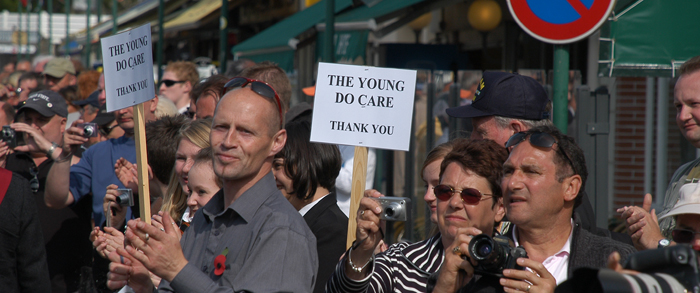
Your photos and your information are very welcome! The young do care and with your help we keep up the good work.