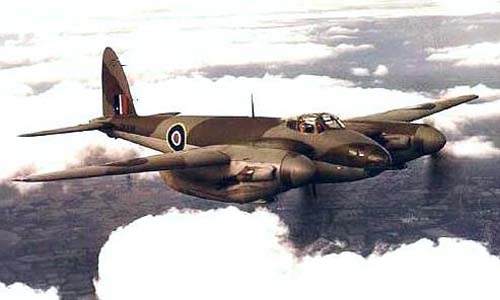
He flew with a de Havilland Mosquito (type XVI, serial PF382, code HS-).
TACTICAL OPERATIONS First Tactical Air Force (Provisional): In France, the 404th Fighter Squadron, 371st Fighter Group, ceases operating from Dijon with P-47s and returns to base at Tantonville.
Ninth Air Force: 3 fighter groups of the IX Tactical Air Command are transferred to the XIX Tactical Air Command to concentrate air power for cooperation with the US Third Army to which the main effort against the Bulge has been assigned; the groups return to control of the IX Tactical Air Command on 25 Dec.
Fighters fly a few strafing, weather reconnaissance, intruder patrol, and alert missions; bad weather cancels all other missions.
In Belgium, the 153d Liaison Squadron, IX Tactical Air Command (attached to Twelfth Army Group), moves from Olne to Tongres (air echelon operating from Liege with L-5s).
207 Lancasters and 1 Mosquito of No 5 Group attacked the synthetic-oil refinery at Politz, near Stettin. 3 Lancasters were lost and 5 more crashed in England. Post-raid reconnaissance showed that the power-station chimneys had collapsed and that other parts of the plant were damaged.
136 aircraft - 67 Lancasters, 54 Halifaxes, 15 Mosquitos - of Nos 4, 6 and 8 Groups attacked the important Cologne/Nippes marshalling yards which were being used to serve the German offensive in the Ardennes. No aircraft lost. The target was cloud-covered and only a few bombs hit the railway yards but these caused the destruction of 40 wagons, a repair workshop and several railway lines.
97 Lancasters and 17 Mosquitos of Nos 1 and 8 Groups attempted to attack railway areas in Bonn but thick cloud cover prevented an accurate raid and later reconnaissance showed that the railway target was not hit. No other details are available. No aircraft lost.
4 Lancasters of No 5 Group to Schneidmühl as a diversion for the Politz raid, 15 RCM sorties, 12 Mosquito patrols, 30 Lancasters and 23 Halifaxes minelaying in the Kattegat. No aircraft lost.
Total effort for the night: 542 sorties, 3 aircraft (0.6 per cent) lost.
Koblenz; 166 Lancasters and 2 Mosquitos, mostly from No 1 Group but with some Pathfinders. No aircraft lost. The aiming point was the Mosel railway yards. There was some cloud in the target area and the local report says that the main weight of the attack fell in farming areas between 2 and 4 kilometres to the west where the villages of Güls and Rübenach were badly hit. But the fringes of the bombing fell on the railway yards, several main lines and 2 important road bridges.
Bingen; 106 aircraft - 90 Halifaxes of No 4 Group and 14 Lancasters and 2 Mosquitos of No 8 Group. 2 Halifaxes and 1 Lancaster lost. The railway yards were again the objective of the raid. The attack was extremely accurate and all the bombs fell into the yards or into the nearby Rhine, where 2 barges were sunk. All movement of supplies by rail through Bingen to the Ardennes battle front ceased.
44 aircraft of No 100 Group flew RCM sorties and Mosquito patrols (the figure cannot be broken down). No aircraft lost.
This record can also be found on the maps of WW2 History Europe with Google coordinates. You can find the maps by clicking on this link on this location.
There are several possibilities to investigate the flight records on WW2 History Europe. All the flights are plotted on maps, sorted "day by day", "by squadron", "by type aircraft", "by year or month", "by location" and much more! Don't miss this!!!
If you have any information that you want to share, please add your comment at the bottom of this record. Or send your information to [email protected]. This information will be added to the record.
Your photos and your information are very welcome! The young do care and with your help we keep up the good work.