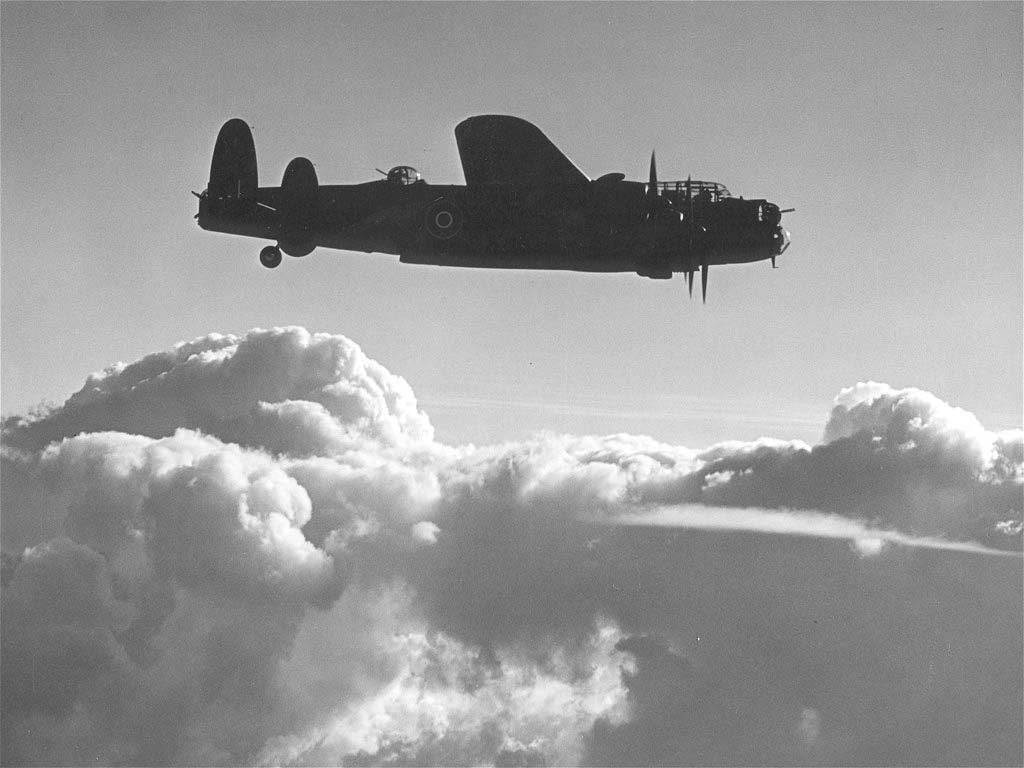
He flew with a Avro Lancaster (type III, serial LM731, code CF-N).
AIRBORNE OPERATIONS
(IX Troop Carrier Command): HQ 440th Troop Carrier Group moves from Exeter, England to Reims.
STRATEGIC OPERATIONS
(Eighth Air Force): Two missions are flown.
Mission 623: 1,131 bombers and 440 fighters are dispatched to hit synthetic oil plants and refineries in Germany; AAF encounters an estimated 525 Luftwaffe fighters; 40 bombers and 17 fighters are lost; AAF claim 115-7-23 aircraft in the air and 42-0-43 on the ground:
1. 384 B-17s are dispatched to hit oil refineries at Bohlen (75), Chemnitz (75), Brux (39) and Ruhland (22); the Chemnitz force is an Operation FRANTIC force that along with 64 P-51s, continues on and lands in the USSR; targets of opportunity are a tire plant at Fulda (66), a marshalling yard at Fulda (40) and 16 others; they claim 12-16-1 aircraft; 16 B-17s are lost, 3 damaged beyond repair and 94 damaged; 2 airmen are KIA, 4 WIA and 153 MIA.
Escort is provided by 252 of 275 P-51s; they claim 57-2-12 aircraft in the air and 26-0-25 on the ground; 4 P-51s are lost, 2 damaged beyond repair and 5 damaged; 4 pilots are MIA.
2. 351 B-17s are dispatched to hit oil refineries at Merseburg (111) and Lutzkendorf (96); targets of opportunity hit are Eisennach (71), Labejum (12), Rossla (6) and 25 others; they claim 1-1-2 aircraft; 13 B-17s are lost, 2 damaged beyond repair and 106 damaged; 2 airmen are KIA, 21 WIA and 120 MIA.
Escort is provided by 247 P-47s and P-51s; they claim 13-0-1 aircraft in the air and 4-0-2 on the ground; 3 P-51s are lost, 2 damaged beyond repair and 2 P-47s and 4 P-51s damaged; 3 pilots are MIA.
3. 396 B-24s are dispatched to hit an engine factory at Hannover (88), oil refineries at Misburg (87) and Magdeburg (33) and an ordinance depot at Magdeburg (27); targets of opportunity hit are Magdeburg (70), Stendal (45), Diepholz (9) and 3 others; they claim 4-8-1 aircraft; 10 B-24s are lost, 2 damaged beyond repair and 179 damaged; 1 airman is KIA, 13 WIA and 102 MIA.
Escort is provided by 164 P-38s and P-51s; they claim 45-5-10 aircraft in the air and 12-0-16 on the ground; 10 P-51s are lost, 4 damaged beyond repair and 7 damaged; 14 pilots are MIA.
Mission 625: 6 of 6 B-17s drop leaflets on France and Germany during the night.
38 B-24s fly CARPETBAGGER missions during the night.
TACTICAL OPERATIONS
(Ninth Air Force): In France, 358 B-26s and A-20s, escorted by fighters, in support of the US Third Army, hit gun positions and strongpoints in the Metz area; in Germany, fighters fly armed reconnaissance over the Lissendorf and Duren areas, and support Third Army ground forces in the Metz area; armored reconnaissance elements of this Army cross into Germany, the first Allied unit to do so; fighters also support ground forces in the Brest, France area; HQ IX Tactical Air Command moves from Versailles to Janoulx, Belgium; HQ 363d Tactical Reconnaissance Group and the 161st Tactical Reconnaissance Squadron move from Azeville to Le Mans and Montrevil respectively with F-6s; HQ 368th Fighter Group and the 395th, 396th and 397th Fighter Squadrons move from Chartres to Laon/Athies with P-47s;
HQ 370th Fighter Group and the 402d and 485th Fighter Squadrons move from Lonray to Roye/Amy with P-38s; HQ 397th Bombardment Group (Medium) moves from Gorges to Dreux; the 386th and 388th Fighter Squadrons, 365th Fighter Group, move from Bretigny to Juvincourt with P-47s; the 394th Fighter Squadron, 367th Fighter Group, moves from Pera to Clastres with P-38s; the 425th Night Fighter Squadron, IX Air Defense Command, moves from Le Moustoiris to Coulommiers with P-61s; the 506th Fighter Squadron, 404th Fighter Group, moves from Bretigny to Juvincourt with P-47s; and the 510th Fighter Squadron, 405th Fighter Group, moves from Picauville to St Dizier with P-47s.
47 Mosquitos to Berlin, 11 RCM sorties, 24 Mosquito patrols, 2 Lancasters minelaying off Texel. No aircraft lost.
218 aircraft - 105 Halifaxes, 103 Lancasters, 10 Mosquitos - of Nos 4, 5, 6 and 8 Groups attacked German positions outside Le Havre. The bombing was carried out accurately in conditions of good visibility but the Master Bomber ordered the final wave to cease bombing because of smoke and dust. 171 aircraft bombed; none were lost.
Two British divisions were now making an attack on Le Havre and the German garrison surrendered a few hours later, but the port was not cleared for Allied use until several weeks later because of German mining and demolitions.
379 aircraft - 205 Halifaxes, 154 Lancasters, 20 Mosquitos - carried out attacks on the Castrop-Rauxel, Kamen and Gelsenkirchen (Nordstem) synthetic oil plants. The first 2 targets were clearly visible and were accurately bombed but the Nordstem plant was partially protected by a smoke-screen which hindered bombing and prevented observation of the results. The 3 forces were escorted by 26 squadrons of fighters - 20 squadrons of Spitfires and 3 each of Mustangs and Tempests. No German fighters were encountered. 5 Halifaxes of No 4 Group and 2 Pathfinder Lancasters were lost from the Nordstem raid and 1 Lancaster was lost from each of the other raids. These loss were caused by flak or by 'friendly' bombs.
5 RCM sorties, 19 aircraft on Resistance operations. No losses.
Darmstadt: 226 Lancasters and 14 Mosquitos of No 5 Group. 12 Lancasters lost, 5.3 per cent of the Lancaster force. A previous No 5 Group attack in August had failed to harm Darmstadt but, in clear weather conditions, the group's marking methods produced an outstandingly accurate and concentrated raid on this almost intact city of 120,000 people. A fierce fire area was created in the centre and in the districts immediately south and east of the centre. Property damage in this area was almost complete. Casualties were very heavy.
The Darmstadt raid, with its extensive fire destruction and its heavy casualties, was held by the Germans to be an extreme example of RAF 'terror bombing' and is still a sensitive subject because of the absence of any major industries in the city. Bomber Command defended the raid by pointing out the railway communications passing through Darmstadt; the directive for the offensive against German communications had not yet been issued to Bomber Command, although advance notice of the directive may have been received. Darmstadt was simply one of Germany's medium-sized cities of lesser importance which succumbed to Bomber Command's improving area-attack techniques in the last months of the war when many of the larger cities were no longer worth bombing.
47 Mosquitos to Berlin and 7 to Steenwijk, 13 RCM sorties, 44 Mosquito patrols, 76 Halifaxes and Lancasters minelaying in the Kattegat. 3 Lancaster minelayers and 1 Mosquito lost in the Berlin raid.
This record can also be found on the maps of WW2 History Europe with Google coordinates. You can find the maps by clicking on this link on this location.
There are several possibilities to investigate the flight records on WW2 History Europe. All the flights are plotted on maps, sorted "day by day", "by squadron", "by type aircraft", "by year or month", "by location" and much more! Don't miss this!!!
If you have any information that you want to share, please add your comment at the bottom of this record. Or send your information to [email protected]. This information will be added to the record.
Your photos and your information are very welcome! The young do care and with your help we keep up the good work.