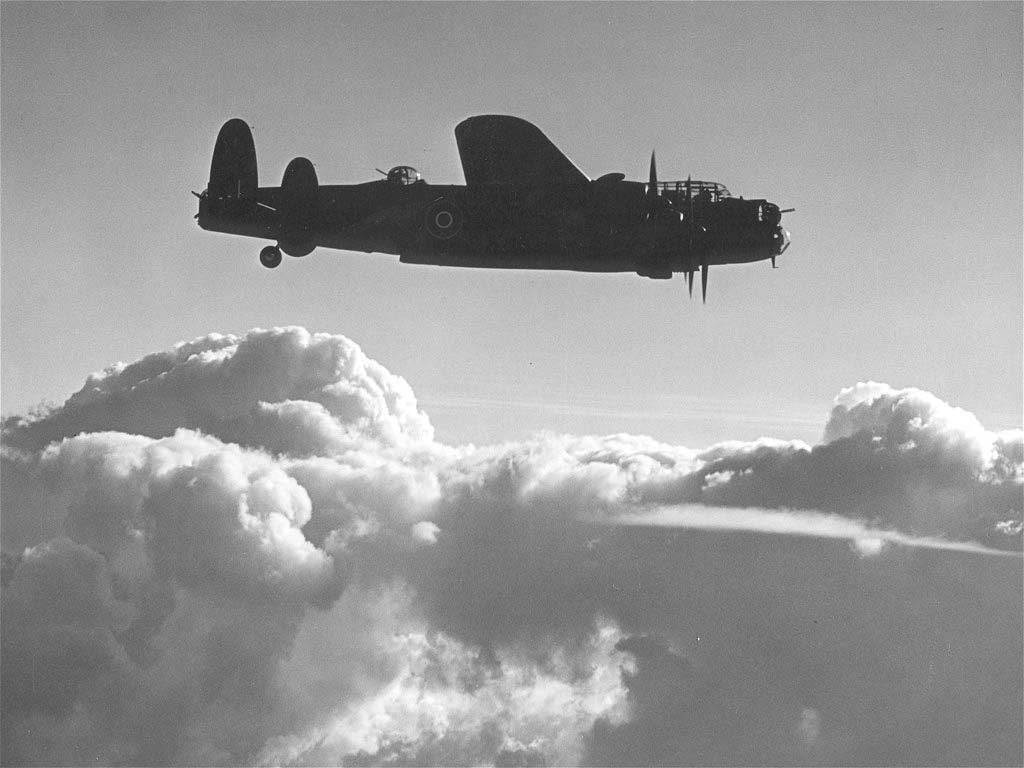
He flew with a Avro Lancaster (type III, serial ND364, code AR-F).
STRATEGIC OPERATIONS
(Eighth Air Force): MORNING OPERATIONS: Mission 325: 223 bombers are dispatched:
1. 116 of 117 B-17s hit Avord Airfield, France; 2 B-17s are lost and 38 damaged; 20 airmen are MIA.
Escort is provided by 118 P-47s and 87 P-51s; they claim 0-0-2 Luftwaffe aircraft in the air and 8-0-3 on the ground; 2 P-51s are lost and 2 damaged; 2 pilots are MIA.
2. 18 of 106 B-17s bomb the Sottevast, France V-weapon site and targets of opportunity; clouds prevent most B-17s from bombing; 2 B-17s are lost and 47 damaged; 3 airmen are WIA and 21 MIA.
Escort is provided by 46 P-47s without loss.
2 fighter-bomber missions are also flown against airfields in France:
1. 34 P-38s using the Droopsnoot method, bomb Tours Airfield; 11 P-38s fly escort; 1 P-38 is lost and 1 damaged; 1 pilot is MIA.
2. 49 P-38s using the Droopsnoot method, bomb Chateaudun Airfield while 3 P-38s fly escort; 1 P-38 is damaged; 32 P-47s, with 4 P-47 escorts, dive-bomb the same target; they claim 1-0-1 aircraft on the ground.
AFTERNOON OPERATIONS: Mission 325: 47 of 47 B-24s bomb the Marquise/ Mimoyecques, France V-weapon sites; 1 B-24 is damaged beyond repair and 6 damaged; 9 airmen are WIA.
Escort is provided by 50 P-47s without loss.
16 P-47s, with 8 escorts, dive bomb an unidentified airfield near Paris without loss.
NIGHT OPERATIONS: Mission 326: 5 of 5 B-17s drop 1.64 million leaflets on 17 towns in Belgium, France and The Netherlands including Antwerp, Brussels, Paris, Tours, Lorient, Nantes, Orleans, Zwolle, Leeuwarden, Turnhout and Amersfoort without loss.
21 B-24s are dispatched on CARPETBAGGER missions without loss.
848th and 851st Bombardment Squadrons (Heavy), 490th Bombardment Group (Heavy), arrive at Eye, England from the US with B-24s; first mission is 4 Jun and 31 May respectively.
TACTICAL OPERATIONS
(Ninth Air Force): 18 B-26s bomb the airfield at Cormeilles-en-Vexin, France as a secondary target.
Nearly 250 B-26s dispatched to bomb marshalling yards are recalled because of heavy cloud cover over the targets.
Friedrichshafen: 322 Lancasters and 1 Mosquito of Nos 1, 3, 6 and 8 Groups. This was a raid with some interesting aspects. The Air Ministry had urged Bomber Command to attack this relatively small town in moonlight because it contained important factories making engines and gearboxes for German tanks. But the flight to this target, deep in Southern Germany on a moonlit night, was potentially very dangerous; the disastrous attack on Nuremberg had taken place only 4 weeks previously in similar conditions. However, Friedrichshafen was further south and on the fringe of the German night-fighter defences; because of this and the various diversions which confused the German controllers, the bombers reached the target without being intercepted. However, the German fighters arrived at the target while the raid was taking place and 18 Lancasters were lost, 5.6 per cent of the force. 1,234 tons of bombs were dropped in an outstandingly successful attack based on good Pathfinder marking; Bomber Command later estimated that 99 acres of Friedrichshafen, 67 per cent of the town's built-up area, were devastated. Several factories were badly damaged and the tank gearbox factory was destroyed. When the American bombing survey team investigated this raid after the war, German officials said that this was the most damaging raid on tank production of the war.
223 aircraft - 191 Halifaxes, 16 Lancasters, 16 Mosquitos despatched to Aulnoye. 1 Halifax lost. Bombing was concentrated and much damage was caused to the railway yards.
144 aircraft - 120 Halifaxes, 16 Lancasters, 8 Mosquitos - to attack railway yards at Montzen on the Belgian-German border. The bombing force, particularly the second of the 2 waves, was intercepted by German fighters and 14 Halifaxes and 1 Lancaster were shot down. Only one part of the railway yards was hit by the bombing.The only Lancaster lost was that of Squadron Leader EM Blenkinsopp, a Canadian pilot of No 405 Squadron who was acting as Deputy Master Bomber. Blenkinsopp managed to team up with a Belgian Resistance group and remained with them until captured by the Germans in December 1944. He was taken to Hamburg to work as a forced labourer and later died in Belsen concentration camp 'of heart failure'. He has no known grave.
159 OTU aircraft on a diversionary sweep over the North Sea, 24 Mosquitos on diversion raid to Stuttgart, 11 RCM sorties, 19 Serrate and 6 Intruder patrols, 8 Halifaxes minelaying off Brest and Cherbourg, 44 aircraft on Resistance operations. 1 Serrate Mosquito lost.
Total effort for the night: 961 sorties, 35 aircraft (3.6 per cent) lost.
88 Lancasters and 4 Mosquitos of No 5 Group to attack an explosives factory near at St Médard En Jalles near Bordeaux. Only 26 aircraft bombed the target. Because of haze and smoke from fires started by flares in woods near the factory, the Master Bomber ordered the remainder of the force to retain their bombs. No aircraft lost.
51 Lancasters and 4 Mosquitos of No 5 Group were dispatched and bombed an airframe factory near Oslo. Visibility was clear; the bombing was accurate and no aircraft were lost.
26 Mosquitos to Hamburg, 2 RCM sorties, 40 aircraft on Resistance operations. No aircraft lost.
This record can also be found on the maps of WW2 History Europe with Google coordinates. You can find the maps by clicking on this link on this location.
There are several possibilities to investigate the flight records on WW2 History Europe. All the flights are plotted on maps, sorted "day by day", "by squadron", "by type aircraft", "by year or month", "by location" and much more! Don't miss this!!!
If you have any information that you want to share, please add your comment at the bottom of this record. Or send your information to [email protected]. This information will be added to the record.
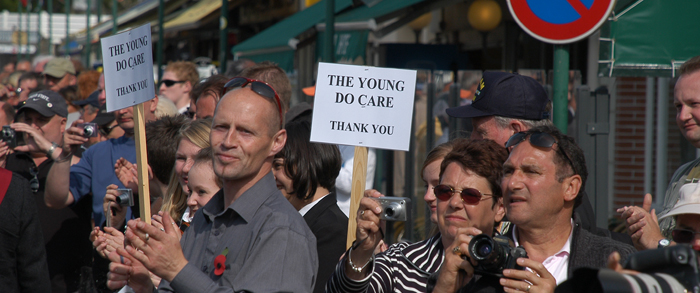
Your photos and your information are very welcome! The young do care and with your help we keep up the good work.