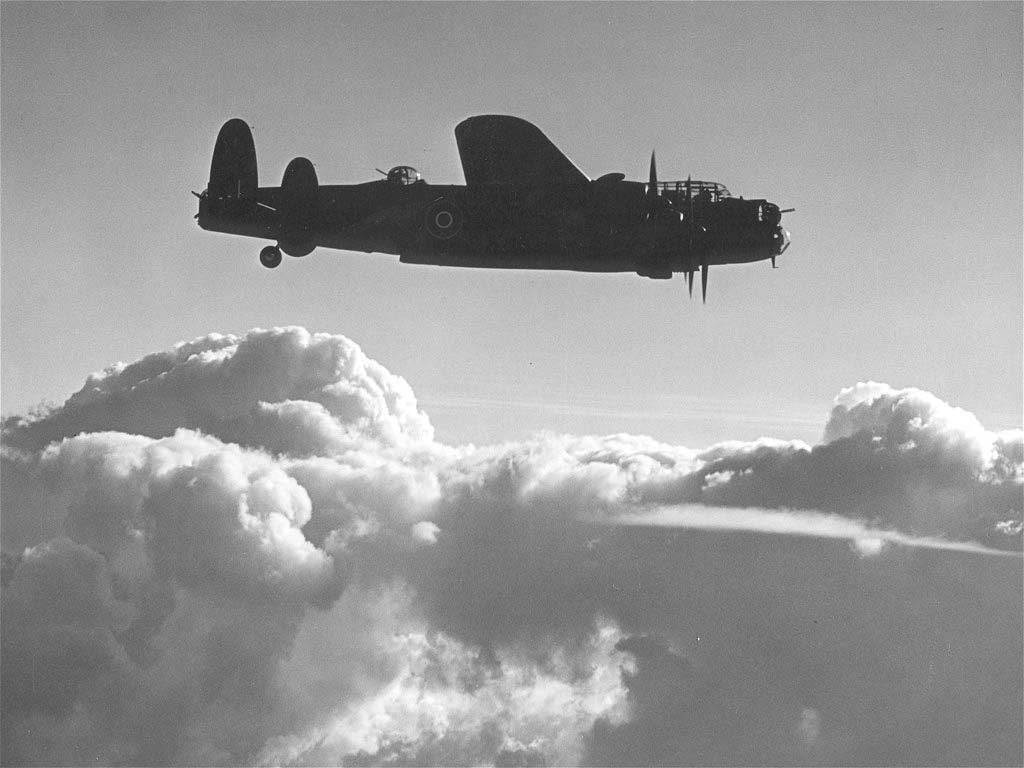
He flew with a Avro Lancaster (type I, serial LM307, code -).
15 December 1943
(Ninth Air Force): The Ninth Air Force comes under operational control of the AEAF. A new directive for tactical bomber operations lists reduction of enemy fighter forces as the basic objective. A Ninth Air Force planning staff, composed of officers who have had service with the Chief of Staff, Supreme Allied Commander (COSSAC), is set up in London.
16 December 1943
STRATEGIC OPERATIONS
(Eighth Air Force): VIII Bomber Command Mission 156: the port area at Bremen, Germany is the target. 402 of 479 B-17's, 133 of 141 B-24's and 10 of 11 PFF aircraft hit the target at 1309-1322 hours; they claim 18-11-11 Luftwaffe aircraft; 10 B-17's are lost; 2 B-17's and 2 B-24's are damaged beyond repair; 128 B-17's, 22 B-24's and 5 PFF aircraft are damaged; casualties are 6 KIA, 8 WIA and 104 MIA.
The mission is escorted by 31 P-38's, 131 P-47's and 39 Ninth Air Force P-51's; they claim 2-0-0 Luftwaffe aircraft; 1 P-47 is lost, 1 P-38 is damaged beyond repair and 1 P-38 damaged; casualties are 1 KIA and 1 MIA.
VIII Bomber Command Mission 157: 4 B-17's drop 1.952 million leaflets over Hannover, Germany; Brussels, Belgium; and Lille, France at 1903-1943 hours; no losses or casualties.
TACTICAL OPERATIONS
(Ninth Air Force): A basic directive for IX Bomber Command training is issued on this date. Since most of IX Bomber Command's combat units have been operational for some time earlier under the VIII Air Support Command, extensive training will not begin until after the first of the year when inexperienced units begin to arrive.
4 Mosquitos to Bochum and 4 to Leverkusen, 3 RCM sorties. No losses.
483 Lancasters and 10 Mosquitos on the main raid to Berlin and 5 further Mosquitos dropped decoy fighter flares south of Berlin. The bomber route again led directly to Berlin across Holland and Northern Germany and there were no major diversions. The German controllers plotted the course of the bombers with great accuracy; many German fighters were met at the coast of Holland and further fighters were guided on to the bomber stream throughout the approach to the target. More fighters were waiting at the target and there were many combats. The bombers shook off the opposition on the return flight by taking a northerly route over Denmark. 25 Lancasters, 5.2 per cent of the Lancaster force, were lost. Many further aircraft were lost on returning to England. Berlin was cloud-covered but the Pathfinder skymarking was reasonably accurate and much of the bombing fell in the city. In the city centre, the National Theatre and the building housing Germany's military and political archives were both destroyed. The damage to the Berlin railway system and to rolling stock, and the large numbers of people still leaving the city, were having a cumulative effect upon the transportation of supplies to the Russian Front; 1,000 wagon-loads of war material were held up for 6 days. The sustained bombing had now made more than a quarter of Berlin's total living accommodation unusable. On their return to England, many of the bombers encountered very low cloud at their bases. The squadrons of 1, 6 and No 8 Groups were particularly badly affected. 29 Lancasters (and a Stirling from the minelaying operation) either crashed or were abandoned when their crews parachuted. The group with heaviest losses was No 1 Group with 13 aircraft lost; the squadron with heaviest losses was 97 Squadron, No 8 Group, with 7 aircraft lost.
47 aircraft - 26 Stirlings, 12 Mosquitos, 9 Lancasters - carried out raids on 2 flying-bomb sites near Abbeville. Neither raid was successful. The larger raid, by the Stirlings on the Tilley-le-Haut site, failed because the Oboe Mosquito markers could not get any closer than 450 yards from the small target. The 9 Lancasters of 617 Squadron which attacked the second site, in a wood at Flixecourt, dropped their 12,000lb bombs accurately on the markers placed by the only Oboe Mosquito operating at this target but the markers were 350 yards from the flying-bomb site and none of the 617 Squadron bombs were more than l00 yards from the markers. No aircraft lost.
2 Beaufighters and 2 Mosquitos of 141 Squadron, recently transferred from Fighter Command to No 100 Group, inaugurated Bomber Command's Serrate operations in patrols near the routes of the Berlin raid. (Serrate was a device which homed on to the radar emissions of a German night fighter.) 1 Mosquito made contact with an Me110 and damaged it with cannon-fire. The crew of this first successful Bomber Command Serrate patrol was Squadron Leader FF Lambert and Flying Officer K Dear.
5 Mosquitos to Duisburg, 35 aircraft minelaying in the Frisians and off Biscay ports. No losses.
This record can also be found on the maps of WW2 History Europe with Google coordinates. You can find the maps by clicking on this link on this location.
There are several possibilities to investigate the flight records on WW2 History Europe. All the flights are plotted on maps, sorted "day by day", "by squadron", "by type aircraft", "by year or month", "by location" and much more! Don't miss this!!!
If you have any information that you want to share, please add your comment at the bottom of this record. Or send your information to [email protected]. This information will be added to the record.
Your photos and your information are very welcome! The young do care and with your help we keep up the good work.