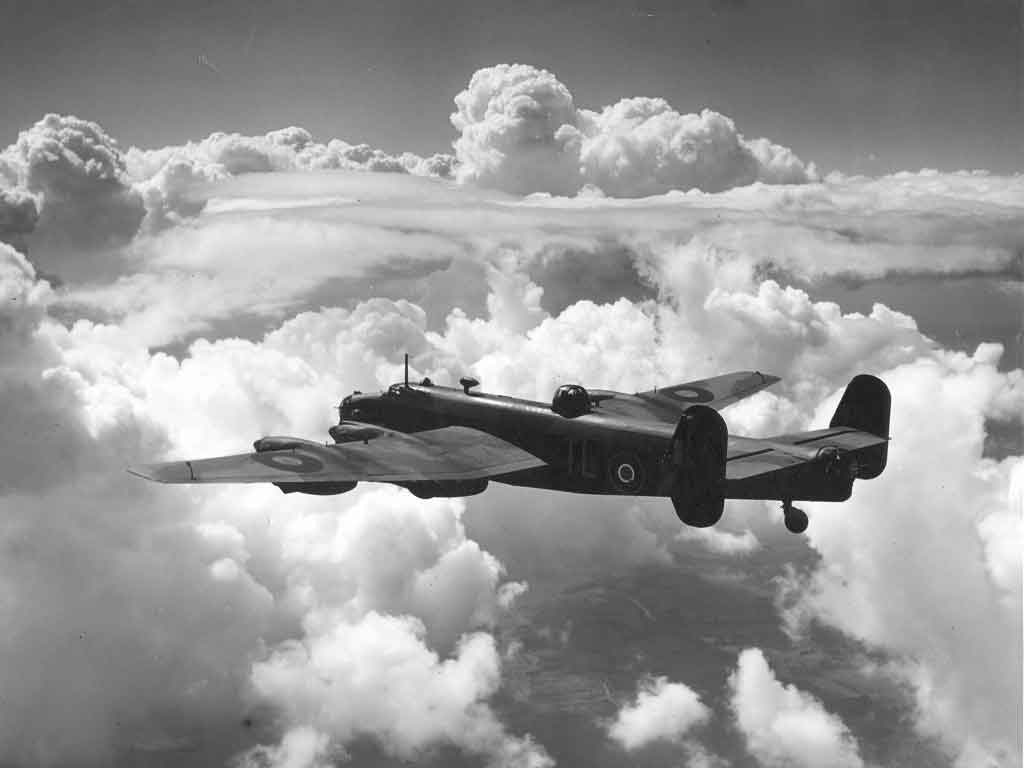
He flew with a Handley Page Halifax (type II, serial HR912, code VR-F).
30 March 1944
STRATEGIC OPERATIONS
(Eighth Air Force): Mission 285: In The Netherlands, 24 P-47 fighter-bombers escorted by 50 other P-47s dive-bomb Eindhoven and Sosterburg, Airfields without loss; 22 other P-47s strafe Venlo, Deelen and Twente/Enschede Airfields; they claim 1-0-0 Luftwaffe aircraft in the air and 1-0-2 on the ground; 1 P-47 is lost and 3 damaged; 1 pilot is MIA.
Mission 286: 6 of 6 B-17s drop 300 bundles of leaflets on Rouen, Rennes, Reims, Paris and Amiens, France at 2125-2155 hours without loss.
HQ 93d Combat Bombardment Wing (Heavy) moves from Elveden Hall to Mendlesham, England; groups will be assigned in May 44.
TACTICAL OPERATIONS
(Ninth Air Force): IX Engineer Command is formally activated by the War Department with Brigadier General James B Newman as Commanding General.
31 March 1944
(Eighth Air Force): HQ 486th Bombardment Group (Heavy) arrives at Sudbury, England from the US.
76 Halifaxes and 8 Mosquitos of Nos 4, 6 and 8 Groups attacked the railway yards at Vaires, near Paris, in bright moonlight. The bombing was very accurate and 2 ammunition trains which were present blew up. 1 Halifax lost.
19 Lancasters of No 5 Group to the aero-engine factory at Lyons, which was bombed accurately. Mosquitos: 32 to Kiel, where 47 people were killed and 134 were injured, 11 to Krefeld, 5 to Aachen and 4 to Cologne. No losses.
This would normally have been the moon stand-down period for the Main Force, but a raid to the distant target of Nuremberg was planned on the basis of an early forecast that there would be protective high cloud on the outward route, when the moon would be up, but that the target area would be clear for ground-marked bombing. A Meteorological Flight Mosquito carried out a reconnaissance and reported that the protective cloud was unlikely to be present and that there could be cloud over the target, but the raid was not cancelled.
795 aircraft were dispatched - 572 Lancasters, 214 Halifaxes and 9 Mosquitos. The German controller ignored all the diversions and assembled his fighters at 2 radio beacons which happened to be astride the route to Nuremberg. The first fighters appeared just before the bombers reached the Belgian border and a fierce battle in the moonlight lasted for the next hour. 82 bombers were lost on the outward route and near the target. The action was much reduced on the return flight, when most of the German fighters had to land, but 95 bombers were lost in all - 64 Lancasters and 31 Halifaxes, 11.9 per cent of the force dispatched. It was the biggest Bomber Command loss of the war.
Most of the returning crews reported that they had bombed Nuremberg but subsequent research showed that approximately 120 aircraft had bombed Schweinfurt, 50 miles north-west of Nuremberg. This mistake was a result of badly forecast winds causing navigational difficulties. 2 Pathfinder aircraft dropped markers at Schweinfurt. Much of the bombing in the Schweinfurt area fell outside the town and only 2 people were killed in that area. The main raid at Nuremberg was a failure. The city was covered by thick cloud and a fierce cross-wind which developed on the final approach to the target caused many of the Pathfinder aircraft to mark too far to the east. A 10-mile-long creepback also developed into the countryside north of Nuremberg. Both Pathfinders and Main Force aircraft were under heavy fighter attack throughout the raid. Little damage was caused in Nuremberg.
49 Halifaxes minelaying in the Heligoland area, 13 Mosquitos to night-fighter airfields, 34 Mosquitos on diversions to Aachen, Cologne and Kassel, 5 RCM sorties, 19 Serrate patrols. No aircraft lost.
3 Oboe Mosquitos to Oberhausen (where 23 Germans waiting to go into a public shelter were killed by a bomb) and 1 Mosquito to Dortmund, 6 Stirlings minelaying off Texel and Le Havre. 17 aircraft on Resistance operations, 8 OTU sorties. 1 Halifax shot down dropping Resistance agents over Belgium.
Total effort for the night: 950 sorties, 96 aircraft (10.1 per cent) lost.
Pilot Officer Cyril Barton, a Halifax pilot of No 578 Squadron, was awarded a posthumous Victoria Cross for carrying on to the target in the Nuremberg operation after his bomber was badly damaged in a fighter attack and 3 members of his crew baled out through a communication misunderstanding. Although the navigator and wireless operator were among the men who had parachuted, Barton decided to attempt the return flight to England in spite of the fact that only 3 engines were running. An unexpected wind took the Halifax steadily up the North Sea and it was short of fuel when the English coast was reached near Sunderland. Barton had to make a hurried forced landing when his engines failed through lack of fuel and he died in the crash, but his 3 remaining crew members were only slightly hurt. Pilot Officer Barton's Victoria Cross was the only one awarded during the Battle of Berlin, which had now officially ended.
This record can also be found on the maps of WW2 History Europe with Google coordinates. You can find the maps by clicking on this link on this location.
There are several possibilities to investigate the flight records on WW2 History Europe. All the flights are plotted on maps, sorted "day by day", "by squadron", "by type aircraft", "by year or month", "by location" and much more! Don't miss this!!!
If you have any information that you want to share, please add your comment at the bottom of this record. Or send your information to [email protected]. This information will be added to the record.
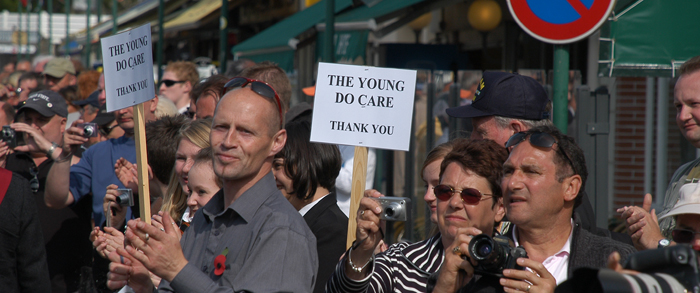
Your photos and your information are very welcome! The young do care and with your help we keep up the good work.