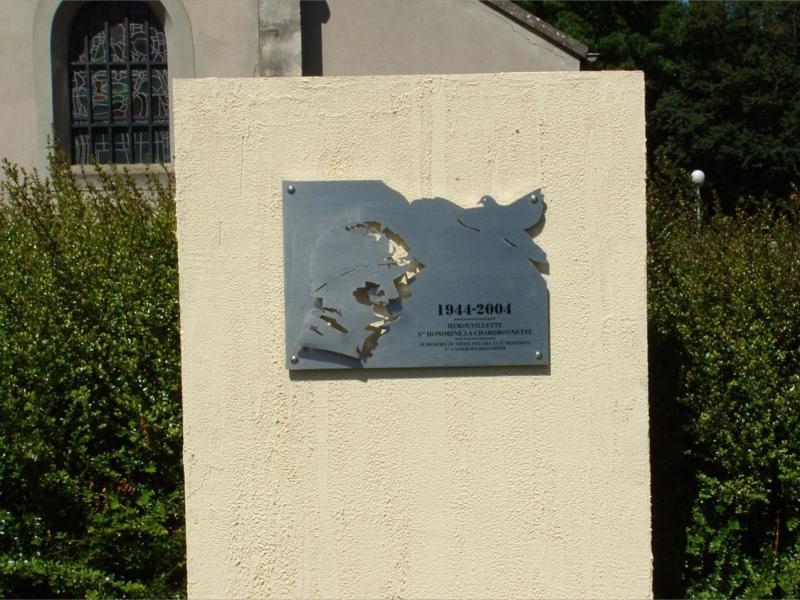
2nd battle of Sainte Honorine la Chardronette. The final orders for the battle were given out by the Commanding officer, Lieutenant-Colonel A. G. F. Monro, at a conference at 14.00 hours on 22nd June 1944. Companies then spent their time making final arrangements and everyone down to section commanders, studied the aerial photographs of the village which were issued to each company.
At 01.00 hours on 23rd June 1944, the companies left their areas and were settled in a battalion concentration area by 02.00 hours. At a forward cross-roads, known as Seaforth corner, a control post was established under the Adjutant, Captain T. B. M. Lamb, in order to marshal the companies through to the start line at the correct times. 'B' company, under Major G. A. Nixon, M.C., moved through first, followed by 'D' company, Lieutenant G. Henderson, 'C' company, Major H. W. Cairns, 'A' company, Major C. W. R. Hill, and finally by 'C' company, 2nd battalion Seaforth Highlanders, Major A. Gilmour, M.C. No preliminary artillery fire had been laid down and as a result, considerable amount of surprise was achieved and maintained, for, at 03.20 hours, 'B' company were reported to be nearing the outskirts of St Honorine.
A few bursts of MG fire and some flares were the only signs of enemy activity up till this time. At 03.30 hours the fighting developed and flares became much more numerous, indicating the enemy were in greater strength than had originally been anticipated. Through heavy Spandau fire our advance continued and by 04.00 hours, the forward companies were reported moving into the village, closely followed by the supporting squadron of tanks of the 13/18 Huzzars under command Major Wormald, M.C.
The enemy fire had now become much heavier and mortars were being used in addition to small arms, and the companies had to fight very hard indeed to make any progress. By 05.00 hours, battalion H.Q. passed a message to Brigade that all companies were probably on their objectives but, owing to communications with some companies having failed, there was not enough evidence for the code-word HAGGIS being given. (This was eventually given at 06.18 hours.) By 05.30 hours, supporting tanks and S.P. guns were in the village, the former doing magnificent work in helping to eject the enemy, and by 06.40 hours the battalion Anti-tank guns were also in position. Even then there were still some enemy scattered over the area, especially snipers, and some considerable time elapsed before they were finally cleared.
In the meantime, air support had been busy. Shortly after 06.00 hours our forward companies reported signs of successful operations on the reverse slopes ahead of them, and the R.A.F. could be seen busy in the neighbourhood of Cuverville. This was a most cheering sight to the battalion at the time. The first appearance of enemy tanks was at about 07.00 hours, from the direction of Cuverville, using smoke to cover their advance. By 07.15 hours, 3 of these tanks were claimed to have been knocked out and soon afterwards another one surrendered. The North-west corner of the village was still in enemy hands but our troops were overcoming them despite the fact that in addition to Mortars, the enemy artillery had been active since 05.00 hours, causing considerable casualties in the battalion.
Between 07.25 hours and 08.00 hours, there was a lull, of which full advantage was taken to organise the company positions as much as possible, though companies were rather depleted now. At 08.00 hours, The 5th battalion, the Seaforth Highlanders, in the area of Longueval, reported further use of smoke by the enemy to cover the movement of his armour and troops, necessary to form up for a counter attack. By now our activities seemed to have aroused the interest of 30 to 40 tanks, probably the remainder of the 21st Panzer Division's armour, East of the river Oorne. These were observed from the air moving West, with the head of their column just South of Giberville, and turning to the North.
By 08.20 hours the codewords, PORRIDGE and WHISKY, were passed back to Brigade denoting that all supporting tanks were in position, mopping up completed, and our own Anti-tank guns with the companies to whom they had been allotted. The presence of enemy tanks in the Giberville - Demouville area was again observed and at 09.22 hours, heavy enemy artillery concentrations were brought down on the battalion positions in the centre of the village, and the wood at the South-East corner. The artillery which had supported the battalion so magnificently throughout the action, engaged the enemy tanks, which were then reported about 1500 yards due South, making use of smoke to cover their advance. This made observation extremely difficult, but at 10.00 hours they were observed forming up and from this time onwards various numbers of tanks were moving towards St Honorine.
At 10.20 hours it became apparent that the enemy infantry were going to attack and the enemy tanks, now numbering 35 MK 1V's in all, formed a line about 2000 yards South-East of the village and 2 Tigers MK V1's, were alleged to be about 500 yards to their rear. 8 of these tanks, supported by strong forces of infantry, were on the outskirts of St Honorine and our depleted companies were faced with the formidable task of repelling this counter-attack. 'C' company, under Major H. W. Cairns, were in the position of having enemy infantry sweeping through their wood from the front, while enemy tanks were moving to their rear.
By sheer doggedness they held their ground, and dealt severely with the enemy infantry, while the Huzzars quickly put the enemy tanks to flight, claiming the leading tank knocked out and probably 2 others just behind. At 11.00 hours, 10 tanks were seen moving West towards Cuverville and were engaged by our artillery, after which some were seen burning in that area. The companies were now very weak and at 10.45 hours the Brigade commander ordered a strong platoon of the 5th battalion The Seaforth Highlanders, to be sent to reinforce the battalion position. The full counter-attack materialised at 11.00 hours but was beaten back by artillery fire and by our infantry, strongly supported by the fire of the 13/18 Huzzars. The 5th battalion, The Seaforth Highlanders, were now ordered to send a company instead of the strong platoon.
Further East at 11.45 hours, 14 tanks were reported forming up, hull-down, in the area of the Cuverville - Escouville road, probably with the intention of supporting their infantry with fire, and these were engaged by our artillery. Owing to the heavy casualties inflicted by enemy Mortar and shellfire, our troops were now becoming very thin on the ground, and first 'A' company, then 'C' company had to withdraw from their areas, to take up positions nearer the centre of the village, while the remains of 'C' company, 2nd Seaforths, were sent along to help our 'D' company, who had been holding out despite their mounting casualties. These had been keeping our unit Medical Officer, Captain W. W. Yellowlees, R.A.M.C, and his staff, working at full pressure since early morning, and no praise can be too high for them or the drivers of the Ambulance jeeps who continued to ferry the wounded back, despite heavy artillery and mortar fire.
Soon after 11.45 hours the enemy tanks were reported withdrawing South from the village and again being engaged by our artillery, which had been firing more or less continuously since soon after first light, and but for whose most valuable support our casualties would have been much greater. By this time the enemy Panzers and infantry had had enough, and at 12.10 hours our own tanks sent in an estimate of 13 enemy tanks and 2 half-tracks knocked out, and as a parting shot, our aircraft engaged 20 enemy tanks in the area North-West of Cuverville, with what was thought considerable success. The village was still subjected to heavy mortar and shell fire after the enemy withdrawal, but at 14.00 hours, the battalion, reinforced by one company of 2nd Seaforths and one company of 5th Seaforths, moved forward and re-occupied most of the village. Things now quietened down until 16.30 hours, when there was some shelling and about 200 enemy infantry were reported forming up about 600 yards from the South-West corner of the village. They were engaged by our artillery and the attack never materialised. At 23.00 hours, the battalion was relieved by the 2nd battalion The Seaforth Highlanders, and took over the area vacated by them. Casualties: Killed = 1 Officer and 70 other ranks. Wounded = 6 Officers and 71 other ranks. Died of wounds = 5 other ranks. Missing = 7 other ranks