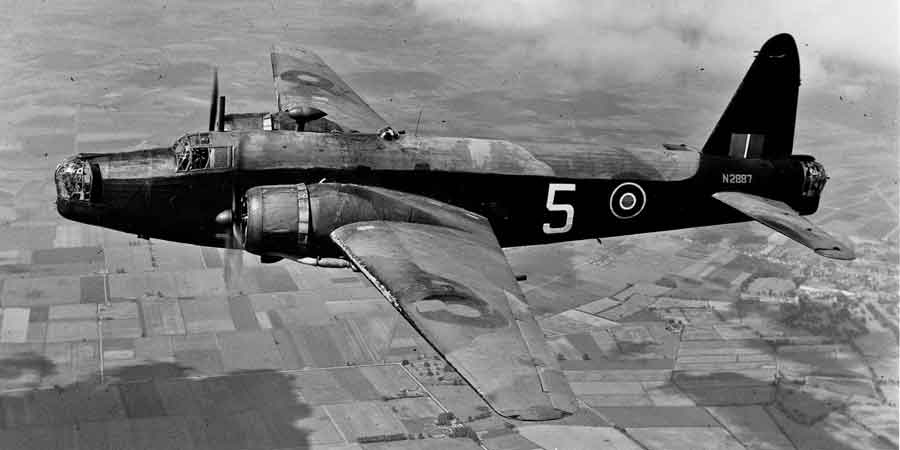
He flew with a Vickers Wellington (type III, serial X3966, code -).
(Eighth Air Force): VIII Bomber Command Mission Number 75: Three targets in Norway are attacked. This is Eighth's first mission to Norway and its longest (1,900 miles or 3,040 km round trip) to date. 1. 179 B-17's and 1 YB-40 are dispatched against the nitrate works at Heroya, Norway; 167 aircraft hit the target at 1317-1414 hours; they claim 9-2-0 Luftwaffe aircraft; 1 B-17 is lost and 53 are damaged; casualties are 3 WIA and 10 MIA.
Work at the plant is disrupted for 3.5 months, and unfinished aluminum and magnesium plants are damaged and subsequently abandoned by the Germans. 2. 45 B-17's are dispatched against the port area at Trondheim; 41 hit the target; they claim 4-2-3 Luftwaffe aircraft; 1 B-17 is damaged beyond repair and 9 are damaged; casualties are 3 WIA. 3. 84 B-17's are dispatched against the port area at Bergen; they find 10/10 cloud cover and return to base with their bombs.
Crews successfully experiment with a new assembly procedure for occasions when bad weather conditions prevent ascent in formation. Aircraft take off individually on instruments, proceed to a designated splasher beacon for group formation, and then along line of 3 splasher beacons for force assembly. The method works well and makes possible many future missions which might otherwise have been abandoned.
7 OTU Wellingtons dropped leaflets over France without loss.
791 aircraft - 347 Lancasters, 246 Halifaxes, 125 Stirlings, 73 Wellingtons involved in the first raid of the 'Battle of Hamburg'. 12 aircraft - 4 Halifaxes, 4 Lancasters, 3 Stirlings, 1 Wellington - lost, 1.5 per cent of the force. 'Window' was used for the first time on this night. Conditions over Hamburg were clear with only a gentle wind. The marking - a mixture of H2S and visual - was a little scattered but most of the target indicators fell near enough to the centre of Hamburg for a concentrated raid to develop quickly. 728 aircraft dropped the bombs bombs in 50 minutes. Bombing photographs showed that less than half of the force bombed within 3 miles of the centre of Hamburg and a creepback 6 miles long developed. But, because Hamburg was such a large city, severe damage was caused in the central and north-western districts, particularly in Altona, Eimsbüttel and Hoheluft. The Rathaus, the Nikolaikirche, the main police station, the main telephone exchange and the Hagenbeck Zoo (where 140 animals died) were among the well-known Hamburg landmarks to be hit. Approximately 1,500 people were killed. This was the greatest number of people killed so far in a raid outside the area in which Oboe could be used.
33 Lancasters of No 5 Group returning from North Africa bombed Leghorn docks but the target was covered by haze and bombing was scattered. No aircraft lost.
13 Mosquitos carried out diversionary and nuisance raids to Bremen, Kiel, Lübeck and Duisburg; 6 Wellingtons laid mines in the River Elbe while the Hamburg raid was in progress and there were 7 OTU sorties. No aircraft lost.
This record can also be found on the maps of WW2 History Europe with Google coordinates. You can find the maps by clicking on this link on this location.
There are several possibilities to investigate the flight records on WW2 History Europe. All the flights are plotted on maps, sorted "day by day", "by squadron", "by type aircraft", "by year or month", "by location" and much more! Don't miss this!!!
If you have any information that you want to share, please add your comment at the bottom of this record. Or send your information to [email protected]. This information will be added to the record.
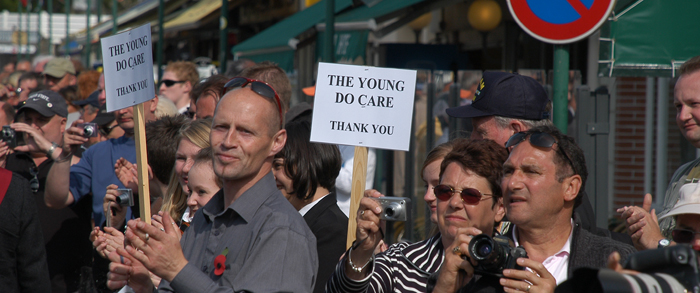
Your photos and your information are very welcome! The young do care and with your help we keep up the good work.