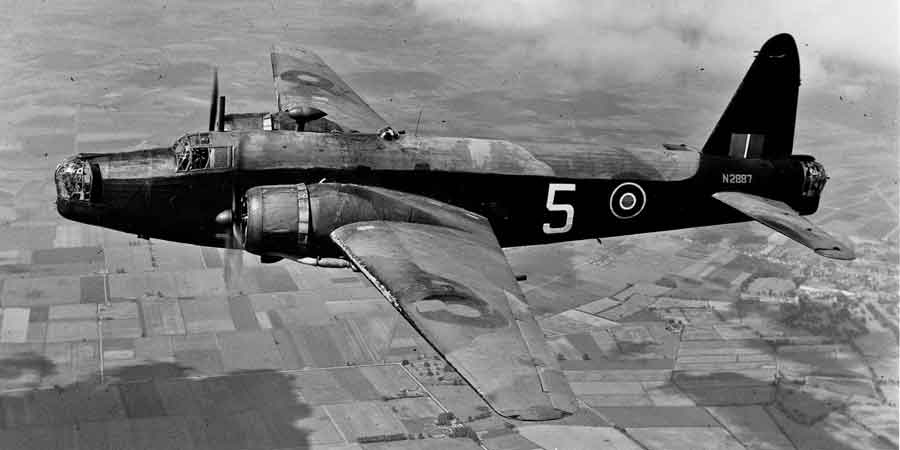
He flew with a Vickers Wellington (type Ic, serial L7874, code GR-S).
March
As is the norm in England during this time of the year, fog played havoc with Bomber Command's operations. Not by only by forcing the cancellation of trips, but also causing many crews to abandon their aircraft upon the return home. The night of 1st/2nd alone saw 14 aircraft lost in this manner. The month saw the operational debut of the Halifax when 6 aircraft from No 35 Squadron joined 8 Blenheims in a raid on Le Havre. Unfortunately, one of the Halifaxes was shot down by an RAF fighter during its return flight - only the pilot and one other man survived.
Barely a month after the oil plant directive, the Command was forced into another theatre of operations - the Atlantic War. Allied shipping losses had risen dramatically since the fall of France less than a year ago and the Air Ministry directed Bomber Command to attack U-boat production factories, docks (containing the virtually indestructible U-boat pens) and airfields when long-range German patrol aircraft operated from. The shipbuilding ports of Kiel, Hamburg, Bremen and Vegesack topped the target list along with U-boat engine factories in Mannheim and Augsburg and airfields in Norway and France. Brest would find itself in the firing line on many occasions when the battleships Scharnhorst and Gneisenau were berthed in the coming months.
It was also during this month that some very prophetic words about the Command's operations were written. Air Chief Marshal Sir Wilfred Freeman, in a directive dated 9th March, he said: "Priority of selection should be given to those [targets] in Germany which lie in congested areas where the greatest moral [sic] effect is likely to result." Despite the unfortunate miss-spelling, it was obvious what Freeman was suggesting, and this, ironically, was taken up by the then Deputy Chief of the Air Staff, Air Vice-Marshal Sir Arthur Harris who, when said of Mannheim and the recently added city of Stuttgart to the U-boat production targets said: "Both are suitable as area objectives and their attack should have high morale value." These two statements would greatly influence future Bomber Command thinking.
With it's new orders, Bomber Command attempted to disrupt the production of U-boats. Hamburg, Bremen and Berlin were attacked by a total of 257 aircraft during the night of 12th/13th March. Hamburg was again the target the following night when 51 people were killed, the highest number so far. Bremen, Wilhelmshaven, Kiel and Lorient (in France) followed in quick succession with Manchesters, Halifaxes and Stirlings all making the debut over German skies in these operations. On the 29th, a daylight attack on the Scharnhorst and Gneisenau was ordered by 6 Blenheims; all turned back because of cloud cover. Three nights later, over 100 aircraft attempted to hit the vessels in Brest harbour - all failed. Blenheims had more success on the 31st against other warships in the Channel. The aircraft were also allowed to attack targets of opportunity on the coasts they were patrolling and several gun positions and troops on parade where attacked in Holland. The night of the 31st March/1st April saw the first use of 4,000lb high capacity bombs (known as 'blockbusters' or 'cookies' by crews) during a raid on Emden.
This record can also be found on the maps of WW2 History Europe with Google coordinates. You can find the maps by clicking on this link on this location.
There are several possibilities to investigate the flight records on WW2 History Europe. All the flights are plotted on maps, sorted "day by day", "by squadron", "by type aircraft", "by year or month", "by location" and much more! Don't miss this!!!
If you have any information that you want to share, please add your comment at the bottom of this record. Or send your information to [email protected]. This information will be added to the record.
Your photos and your information are very welcome! The young do care and with your help we keep up the good work.