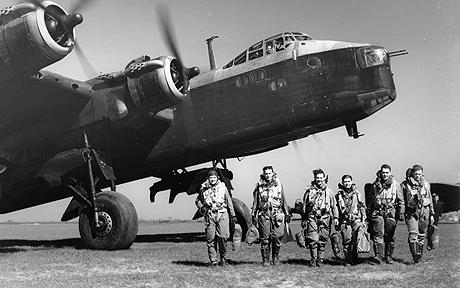
On Tuesday 18 May 1943, a member of the 138 Sqdn, Flight Lieutenant R W J Hooper, took off from an unknown RAF station in the United Kingdom. His mission is mentioned elsewhere on WW2 History Europe. You can find the other details of this mission by searching here. Training and cargo flights are not separately mentioned as a mission. The plane left at an unknown time . He flew with a Handley Page Halifax (type II, serial JB802, code NF-S).
Campaign report of the USAAF:
(Eighth Air Force): The Combined Bomber Offensive (CBO) plan for the round-the-clock bombing of the enemy from the UK by the RAF and Eighth Air Force is approve by the Combined Chiefs of Staff (CCS). The Eighth Air Force now has authorization to proceed with daylight strategic bombing within the type of combined offensive it has long wished to initiate. The CBO plan lists the destruction of German fighters as the immediate priority objective. Primary objectives in order are German submarine yards and bases, the German aircraft industry, ball bearings, and oil (the last being contingent upon attacks from the Mediterranean against Ploesti, Rumania). Secondary objectives in order of priority are synthetic rubber and tires, and military motor transport vehicles.
Campaign report of the RAF:
17/18 May 1943
3 Mosquitos to Munich, 6 aircraft minelaying off La Pallice. 1 Stirling minelayer lost.
18 May 1943
13 Bostons bombed Abbeville airfield without loss.
18/19 May 1943
13 Lancasters and 4 Wellingtons minelaying off Brest and in the southern part of Biscay. No losses.
With thanks to the RAF and USAAF.net!This record can also be found on the maps of WW2 History Europe with Google coordinates. You can find the maps by clicking on this link on this location.
There are several possibilities to investigate the flight records on WW2 History Europe. All the flights are plotted on maps, sorted "day by day", "by squadron", "by type aircraft", "by year or month", "by location" and much more! Don't miss this!!!
If you have any information that you want to share, please add your comment at the bottom of this record. Or send your information to [email protected]. This information will be added to the record.
Your photos and your information are very welcome! The young do care and with your help we keep up the good work.