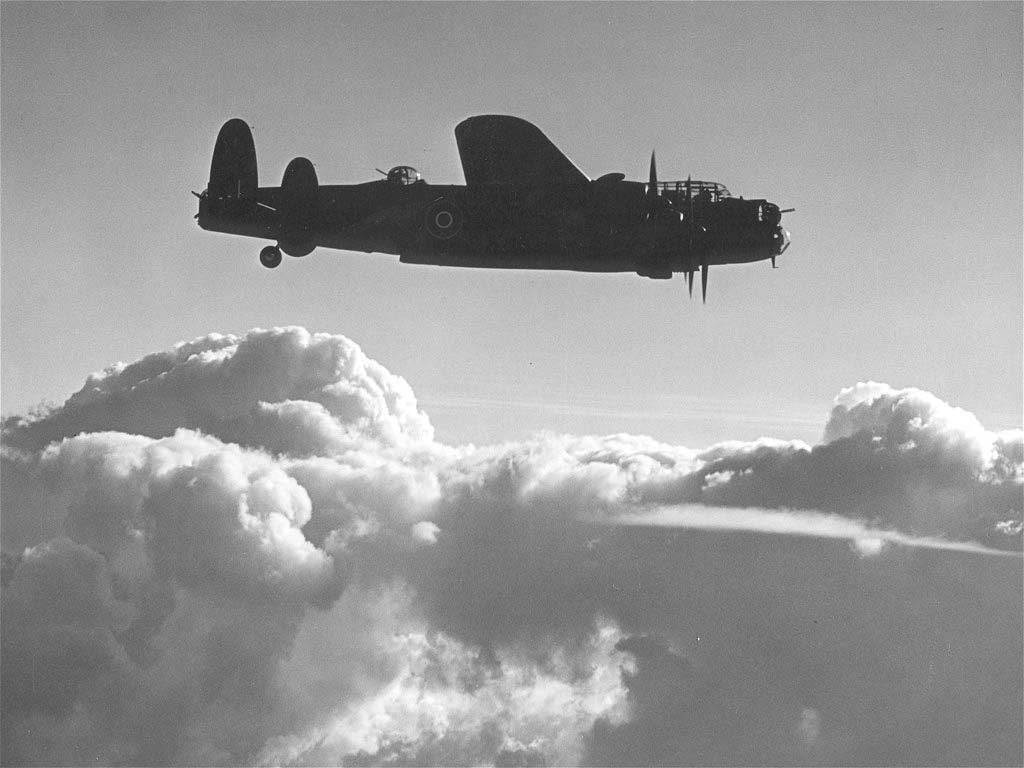
He flew with a Avro Lancaster (type I, serial PD222, code KM-U).
STRATEGIC OPERATIONS
(Eighth Air Force): Mission 552: 1,183 bombers and 429 fighters are dispatched to attack 9 airfields, 2 aero engine factories, 1 oil plant, 2 bridges, 2 rail junctions and other secondary and targets of opportunity in SW Germany, E France, and the Bordeaux, France region; 2 bombers and 1 fighter are lost (numbers in parenthesis indicate number of bombers attacking the target):
1. Of 376 B-24s dispatched to France, the following airfields are hit: Lyon/Bron (108), Dijon/Longvi (83) and Dole/Evaux (70); bridges hit are at Anizy (46) and Fismes (34); and 12 B-24s hit Liart rail junction and 1 hits a target of opportunity; 1 B-24 is damaged beyond repair and 32 are damaged; 2 airmen are WIA.
Escort is provided by 92 P-47s and P-51s without loss.
2. 77 B-24s are dispatched to hit French rail junctions at Saintes (38) and Angouleme (38) without loss.
Escort is provided by 40 of 42 P-51s without loss.
3. 349 B-17s dispatched to Germany hit Ludwigshafen (144), Mannheim (110) and Mannheim/Sandhofen Airfield (72); 4 others hit targets of opportunity; 2 B-17s are lost and 232 damaged; 8 airmen are WIA and 18 MIA.
Escort is provided by 88 of 99 P-51s without loss.
4. 381 B-17s dispatched to Germany hit airfields at Hagenau (92), Metz/ Frascaty (72), Florennes (24) and Chievres (9); and Stuttgart/Echterdingen (72), Kaisereslautern (46), Sindelfingen (12), Trier (10) and targets of opportunity (16); 20 B-17s are damaged.
Escort is provided by 168 of 193 P-51s; they claim 10-0-11 Luftwaffe aircraft; 1 P-51 is lost (pilot is MIA).
Mission 553: 6 of 6 B-17s drop leaflets in France during the night; they claim 1-0-0 Luftwaffe aircraft.
37 B-24s fly CARPETBAGGER missions in France; 1 B-24 is lost.
136 P-38s and P-47s fly fighter-bomber missions in the Paris area; they claim 3-0-0 aircraft; 1 P-38 and 2 P-47s are lost, 1 P-47 is damaged beyond repair and 2 P-47s are damaged; 2 pilots are MIA.
The 36th Bombardment Squadron (Heavy), VIII Air Force Composite Command, moves from Harrington to Cheddington, England with B-24s; the squadron will convert from CARPETBAGGER to ECM missions over Europe.
TACTICAL OPERATIONS
(Ninth Air Force): In France, A-20s and B-26s with fighter escort hit several highway and rail bridges, junctions and sidings mostly beyond the battlelines to delay and complicate the German retreat; fighters fly armed reconnaissance over the Falaise, Broglie, and Chartres areas, and support ground forces, especially 7 armored and infantry divisions, over wide areas of N and W France; a XIX Tactical Air Command squadron uniquely effects the surrender of a number of German ground troops, Germans on roads being strafed by the squadron NE of Carrouges wave white flags, whereupon the planes buzz the road and shepherd the enemy troops into a column which then proceeds to US lines to surrender; HQ 358th Fighter Group and the 365th, 366th and 367th Fighter Squadrons move from Cretteville to Pontorson with P-47s; HQ 367th Fighter Group moves from Beuzeville to Cricqueville; and the 355th Fighter Squadron, 354th Fighter Group, moves from Cricqueville to Gael with P-51s.
30 Mosquitos to Hannover, 22 RCM sorties, 15 Mosquito patrols, 10 Halifaxes and 5 Lancasters minelaying off Biscay ports, 4 Halifaxes on Resistance operations, 9 OTU sorties.
No aircraft lost.805 aircraft - 411 Lancasters, 352 Halifaxes, 42 Mosquitos - to attack 7 German troop positions facing the 3rd Canadian Division, which was advancing on Falaise. 2 Lancasters lost. A careful plan was prepared with Oboe and visual marking, and with a Master Bomber and a deputy at each of the 7 targets. Most of the bombing was accurate and effective but, about half-way through the raids, some aircraft started to bomb a large quarry in which parts of the 12th Canadian Field Regiment were positioned. This mistake may have been caused by the yellow identification flares which were ignited by the Canadians. It was unfortunate that the target indicators being used by the Pathfinders were also yellow. Bomber Command crews claimed that the Canadians used the yellow flares before any bombs fell in the quarry; the history of the Canadian units says the bombs fell first. The Master Bombers tried hard to stop further crews bombing in the wrong area but approximately 70 aircraft bombed the quarry and other nearby Allied positions over a 70-minute period. The Canadians took shelter in their slit trenches and most emerged unscathed though shaken, but 13 men were killed and 53 were injured and a large number of vehicles and guns were hit. This was believed to have been the first occasion on which Bomber Command aircraft had hit friendly troops during the Battle of Normandy. The Canadian artillery regiment was machine-gunned by RAF Spitfires and USAAF Mustangs the following day!
155 Lancasters and 4 Mosquitos of No 5 Group made two separate attacks on ships in Brest harbour. The Clemenceau and the cruiser Gueydon were both hit and were believed left sinking in 'safe' positions which would not hinder Allied use of the port when American troops took possession. The Allied forces were anxious to capture a good port to which supplies and reinforcements for the land battle could be brought in directly from the United States. 2 Lancasters were lost.
Details of the Canadian side of the bombing come from Into Action with the 12th Field by Captain TJ Bell (published privately in Canada} and from the personal reminiscences of former Lance-Corporal George R Carter of the 12th Canadian Field Regiment. George Carter's brother, Flying Officer Roy E Carter of No 431 Squadron, was a Bomber Command navigator whose Halifax had been shot down over Holland on the Sterkrade raid of 16/17 June 1944. Roy Carter baled out successfully but, while he was being hidden by Dutch civilians in a house at Tilburg, he was discovered by Germans on 8 July and shot, together with a Pathfinder pilot and an Australian airman. The bloodstained Dutch flag which covered the bodies after their death was brought to England in 1983 and placed in the No 83 Squadron Memorial Chapel in Coningsby parish church.
1 Wellington flew an RCM sortie.
Total effort for the day: 965 sorties, 4 aircraft (0.4 per cent) lost.
32 Mosquitos to Berlin, 2 to Sterkrade oil plant and 2 to St Trond airfield, 1 RCM sortie, 8 Halifaxes and 6 Lancasters minelaying off Biscay ports, 4 aircraft on Resistance operations, 7 OTU sorties. No losses.
This record can also be found on the maps of WW2 History Europe with Google coordinates. You can find the maps by clicking on this link on this location.
There are several possibilities to investigate the flight records on WW2 History Europe. All the flights are plotted on maps, sorted "day by day", "by squadron", "by type aircraft", "by year or month", "by location" and much more! Don't miss this!!!
If you have any information that you want to share, please add your comment at the bottom of this record. Or send your information to [email protected]. This information will be added to the record.
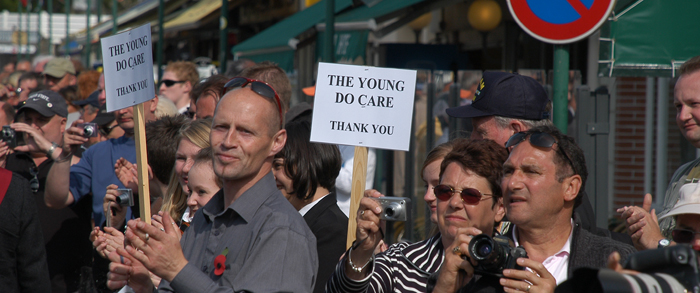
Your photos and your information are very welcome! The young do care and with your help we keep up the good work.